
An image came up in one of my recent somatic therapy sessions. Not of moving out, but moving in. Moving in with myself. Back at home, I began to explore and study this curious idea. To invite it in, to try it on. This began weeks before the possibility of an actual physical move out of my home was even on the table.
What does it mean to move in with myself? Is it to tend to myself? To make a home within myself, wherever I am? To get to know myself anew, without the medications and the labels and the constant storyline of what I need to manage and control? What could it feel like, to welcome in all my parts, to be at home in my own skin, throughout this whole tumultuous journey of life?
It is first of all, I realize, an invitation to prioritize myself. To center myself. To accept myself. All of myself. Something that it’s very easy, when avoiding uncomfortable feelings or being driven blindly by trauma responses and triggers, or simply considering myself an unworthy vessel, not to do.
It was also an invitation for spring cleaning. To throw open the doors and bring everything into the light. To clear away the cobwebs. Even to consider redecorating my insides. And to let all my parts re-gather themselves - from wherever they’d scattered to - and re-integrate themselves into an internal family system of wholeness. To let them know, hey, you are welcome here. You, too. All of you. Welcome in. Welcome home. You belong.
Belonging? That’s been a wound forever, and I’m not the least bit unique in this regard. In fact, “I don’t belong” is one of the most common limiting beliefs we can carry. I once heard a rabbi joke about it, saying “you know that feeling that you don’t belong? That’s how you know you do.” It’s funny and it hurts and it’s true. But in any case, until we learn to neutralize them, our limiting beliefs run our shows. And this one’s always been a champ at running mine.
And if I don’t belong, how can I possibly be home, anywhere?
Growing up, obviously I didn’t know everything I know now about how definitions create reality. How beliefs create reality. I just knew I didn’t belong. Not at home, not at school, not anywhere. As a neurodivergent kid, a queer kid, a brilliant kid, a depressed kid, a spiritual kid, I never fit in.
There is one shining exception. For two weeks every summer, I was far away from home, away from everybody I knew in my ordinary life, at 4-H camp. There, I was fully welcomed and fully embodied. There, I actually felt seen. But I didn’t even use my given name in that place, so laden with trauma had it become. No. To find this freedom, I left all my not-belonging labels at the door. I became somebody else entirely. The rest of the time, not belonging was so close to my core that it felt like the truest thing about me. A close second was, “I’m broken.” But we’ll save that one for another time…
And so I began exploring this moving in with myself. You know what it means to me, really? It’s a homecoming. A self-acceptance. A commitment to, and a cultivation of, my intrinsic internal coherence. Coherence? It turns out this is the place where insights come from. This is where intuition rises from. So this is the state I want to be cultivating.
What creates this coherence, for me today? Many things. Meditation and prayer. Basic mindfulness and stillness. Music, chanting and song. Breathing. Invocation. Ceremony. Physical movement and dance. I don’t always take the same pathways in, but there are core ingredients of Presence, and one of them will pretty much always work, if I let it. If I give it the chance. These are the tools I can rely on for moving inwards now, for looking inwards, moving in with myself.
This reminds me. “Buddhist” is not a translation of any actual Tibetan word. That’s just some lazy English glossing. The word that Tibetans use for Buddhist practitioners is nangpa.1 It means insider. Those who turn within to the nature of mind to find absolute truth.
Being an insider. THAT’s moving in with myself. Moving in beyond my egoic identity, beyond my small self. Moving in to the heart of the matter. Moving into my heart.
A massive part of this is moving in with my inner kid. My little Play. Telling her (or him, or they, or whatever. Pronouns are so ridiculous to me) that I’m on their side. That we’re a team.
In my intuitive coaching work, REAL CHOICE is a large component of what I teach my clients. Making choices gives us a foundation and orientation into living as a creator, taking radical self-responsibility for our lives, tapping into our sacred imagination, and choosing from our heart, regardless of circumstances. Sometimes the choices don’t seem to make any sense. Sometimes, those no-sense choices are the strongest ones.
For the past year I’ve held a choice of choosing the end result of my very own studio and home. I didn’t know what it meant when I first got it, because the image that accompanied it, in the beginning, was definitely not where I lived. And every time I tuned into it, it seemed like it required renting an extra place, which felt impossible, or moving, which I told myself I didn’t want to do.
Working with choices puts us in creative tension. There’s always a gap between where we are, and where we want to be. Tension is uncomfortable, but you can’t be a creator without it. The trick is to hold the structure of it AS creative tension, and not get caught up in the emotional and psychological discomfort of it, looking for an easy out, a resolution that does nothing but make me “feel better” by dropping the vision altogether. So despite the discomfort around this choice, I tuned into it daily, and stayed curious, and held the tension. It didn’t feel like it was going anywhere - for months - which just made the tension worse. As a result, I spent a lot of time trying to reassure myself that it was probably just a metaphor. This, of course, did not work.
It seems it was not a metaphor at all. I have, in fact, “moved out.”
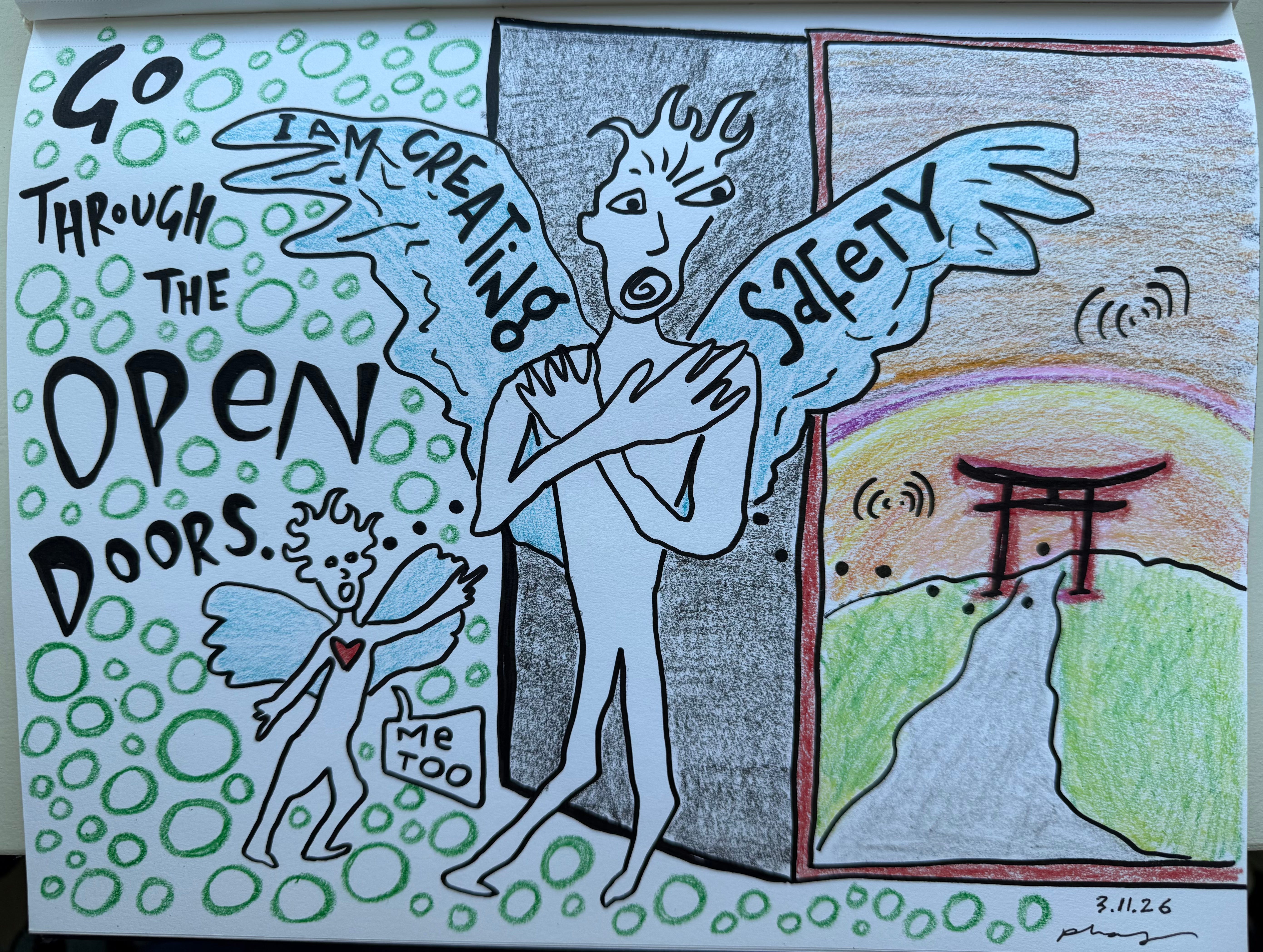
But what if this choice is also, even more, about moving IN?
What if “my very own studio and home” isn’t just the well-lit third story room of the house I’m about to inhabit? What if it’s about ME being my own studio and my own home?
What if it’s about me becoming a safe place for myself? I’m creating safety, I keep reminding myself. Another theme from my somatic work. I’m bearing witness and integrating disparate parts. Letting them oscillate and reveal themselves in turn, until they begin to cohere and coalesce. Even when it doesn’t look or feel like I’m making much headway yet, that’s the work I’m doing. Creating safety where it wasn’t before. And my inner kid? Little Play? They’re buying in. We’re in this together. Going through the open doors.
The closest I ever got to killing myself, I was 19 years old. A junior in college (yes, that’s young. I have a summer birthday, and I skipped sixth grade). It was early spring, the hardest season of the year for me in those days, and I’d been waging a losing battle with myself for months. Therapy wasn’t working. The drugs weren’t working. I was coping with more volatility internally, gutting it out through wrenching bouts of depression. A good friend, a fellow addict-to-be, would come over to my house in the mornings. He’d let himself in and start cooking me breakfast. He’d bring me coffee. Get me out of bed. Feed me, and then together, we’d get as stoned as absolutely possible. Only then was I willing to leave the house for class. Only then, was I willing to face the day.
As I wrote about last week, therapy did help, in its own dangerous way. I gathered more coping strategies. More self-awareness. But no real tools of change. Instead, I just hung in there longer each time before I crashed. And the result was a breaking point more deadly each time it finally came.
It was a Tuesday afternoon, and I’d driven home from school. These were the days before automatic garage door openers, so I pulled into the driveway, got out, opened the garage, pulled in, and then made a decision. I got out of the car, shut myself into the garage, and climbed back in the driver’s seat, engine still running. Easy. Undramatic. All I had to do was sit there.
I don’t remember if any music was playing. I don’t remember what I was thinking about. It wasn’t premeditated. I just remember that this occurred to me as the neatest and cleanest and most direct thing I could do, to take control of myself and how I felt. Funny, how that’s exactly how my father took his own life, seventeen years later.2
I sat there for what felt like a long time. The simplest way to tell it is, my bladder saved my life. I had to pee. I had to pee so bad. Sitting still, doing nothing, with a full bladder? It sucks. I was squirming. And I couldn’t anticipate the relief of death when even more, I needed the relief of a toilet. And yes, I know it’s common to evacuate yourself at the moment of death, but I sure wasn’t willing to piss myself, alive, and then sit in it, growing wet and cold there, soiling that little VW Jetta that I’d so loved, breathing in the stench of urine along with the exhaust, pathetically waiting to die.
Maybe my will to live was hiding out in my bladder all this time, laying in wait for the moment when it could expel the toxins of self-destruction from my body. I don’t know. It doesn’t matter. What matters is, eventually, my urgent need to pee overpowered my less urgent need to die. So I turned off the car, opened the garage, walked to the house and went inside. And for some reason, after using the bathroom, it didn’t seem so important to go back out to the garage.
I disappeared for several days then. Went dark, shuttered myself inside. No-showed at my job and all my classes. Didn’t answer the phone or the door when anyone came by.
This is the moment that shook me awake. The moment when I realized that everything the mental health field had to offer me was still just a one-way ticket to self-destruction and death. That all the work I’d done, all the self-improvement, all the compliance with psychiatric care and the cocktails of different drugs, all the efforts in therapy, would only ever get me here. To a breaking point that would kill me. I could see the trajectory clearly. I wasn’t making progress - quite the opposite. At this rate, the next time would only ever be worse.
This is when I decided I needed another plan. Another paradigm. Another way. I was determined to prove to my nurse psychiatrist that I could take matters into my own hands. That I could find a viable alternative. It wasn’t a straight line. My “other way” involved, among other things, beginning to selling drugs, smoke opium, have unprotected sex, get pregnant, and have an abortion. It was a big summer.
But along with all that mess, I turned towards some spiritual tools. I didn’t have teachers yet, I only had books - which are not remotely the same thing. But I got my hands on one that, even in the clouds of my own frantic delusion, I could understand. Shambhala: The Sacred Path of the Warrior, by Chogyam Trungpa.
The core premise of Trungpa’s book is that our fundamental nature isn’t broken - it’s good. I’d never heard of buddha nature before. He didn’t even use that phrase. He just laid out an argument that our inherent true nature transcends our wounded self. That it is basically unharmed and unharmable. It’s basically good. And that was a bet, at twenty years old and desperate for life, that I was willing to make.
———
I don’t need any more tools, I keep being told by my somatic therapist now. And she would tell me if I was shirking my work or bypassing anything. She knows the stakes of the game. We began working together from the moment I started titrating off the meds in early winter. What I need, she says, is this: to go deeper into, and further with, the tools I already have.
This is important. It signals a very new story. It means that being with myself IS fundamentally safe. That I am, at the most basic level, as I began to faintly believe that summer long ago, fundamentally good, not broken or lost. It means that I don’t have to look outside for the medicine. That I can start to relate to myself AS the medicine I seek.
So I am moving in with myself. Finding my truth, beneath and behind and beyond all the noise.
My nurse psychiatrist is still standing by to gently remind me that I can restart any of the meds if I need them, anytime. I do not intend to need them. That is not what I am choosing for my end result.
I am choosing the end result of my very own studio and home. My new home in geographic and architectural space, yes, and also my home and creative space in my own body and mind. Claiming my own neurology and biology and psychology and psyche as hospitable territories. Claiming all the parts of myself as valuable, as assets, as allies. Entering the wilderness of my own basically good self with acceptance, even in the turbulence.
Because I belong here. Wherever I am. And so do you.
https://www.rigpawiki.org/index.php?title=Nangpa
see episode 7 of Father. Mother. God. https://globalcomix.com/read/5b5115bd-22f4-4d5a-9701-4f302275950a/1


